Planning Landscape Photography Around Tides
As landscape photographers, we have to work with weather conditions that are given to us. We do not choose the conditions we will get for a specific photo shoot…the nature of being a landscape photographer is that we have to work around what ever Mother Nature gives us.
However, we can choose where we want to capture a lovely scene based on what kind of conditions we will get. I love to use applications such as Windy to predict cloud coverage, precipitation chances and overall weather conditions. Now when it comes to seascape photography, we have an extra factor to keep in mind; Tide.
And Tide Swings often is a factor that a lot of people tend to forget. In this article, I will rapidly cover different reasons why you should definitely not forget about this strange phenomena which is Tide Swing.
WHAT EXACTLY CAUSES TIDES?
Tides are the rise and fall of sea levels caused by the combined effects of the gravitational forces exerted by the Moon (and to a much lesser extent, the Sun) and are also caused by the Earth and Moon orbiting one another. I did not write these words…I found this on Wikipedia! I am not a scientist…all I know is that tides can either create or break dreams when it comes to landscape photography. We have to learn how to work with tides!
Another cool fact is that the further you go north or south, the more tide swings you are likely to see. A friend of mine that lives on the lovely island of Curacao in the Caribbean told me that they barely have tidal swings if any…once again, even though this can be seen in real life situations, it is once again far from being a scientific explanation. Many other factors such as how deep the water is will affect tides. But we aren’t here to talk science! We are here to talk photography! Right?

WHY SHOULD I CARE FOR TIDES?
First of all, for your own safety! Earlier, I mentioned that a lot of people tend to forgot to look at Tide Charts before going somewhere that will be affected by Tidal Swings. How many times did I bump into someone that was surprised that the water level came up? Some of them even had to get their feet wet! But getting our feet wet isn’t that much of a big deal…the bigger problems come when you are trapped somewhere dangerous and can’t make it back to where you are coming from. And more specifically on a stormy day, if the ocean becomes rowdy and waves become quite agitated, this whole situation could even become life threatening! Tide swings can go from 0,10 centimeters above sea level to 4 meters above sea level or even more! That’s a lot of water if you ask me!

TIDES MAKE A HUGE DIFFERENCE!
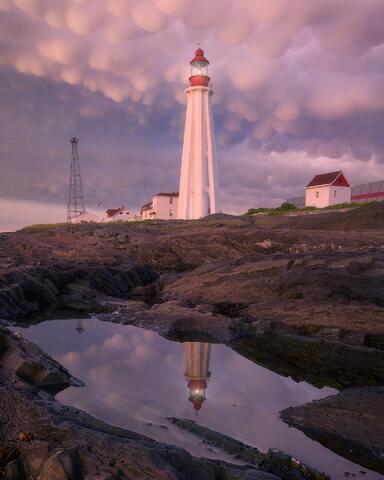
It makes a huge difference when you want to create an image! The quality or the impact of a foreground will be greatly affected by tides. At high tide, you might only have a water covered foreground but when that tide goes away and unveils a whole treasure, you are guaranteed to have your mind blown!
You might ask yourself: What exactly could I find of that much of an interest at low tide? You could find some lovely tidal pools, algae covered boulders, marine plants, star fish or even urchins…and so much more! I don’t know about you but I much prefer a nice detailed foreground to any boring water filled scene with zero elements. A foreground with a few elements is great to anchor my viewers’ eyes and bring them to my main subject! But don’t get me wrong, waves can also create some really nice dramatic foreground too. Just be open to any type of scenario! There is no ideal recipe here…some scenes will work better with a high tide while others will be optimal at low tide.


HOW DO I PREDICT THE TIDES?
We use official sources to look at weather forecasts don’t we? There are also many official sources that will predict Tides too! In fact, every country that has ocean front land should have its own official Tidal Chart Website for fishermen to use! The Government of Canada as a really nice website that works very well! All we have to do is choose a station, type in the dates you want tide predictions for and voilà! Plain and simple! I love the fact that we can have hourly predictions for many months prior. This makes seascape photography so much easier! Always try to find Tide Charts from a station that is as close as possible to you since they can vary a lot. Two cities that are two hours apart will have different Tidal Swings and high tide and low tide will occur at slightly different times too.
But then again, even though you have THE perfect tide conditions, will the weather be cooperative? Landscape photography sounds so easy to many when it’s in fact a big game of planning, scouting and luck all together! Even though these are only predictions, the real tide heights could vary a little bit…but in all honesty, it was never that far off that I had to change my plans! Science and technology are so good that we can rely on them and make good use of science in order to create art!

HOW TO PROCEED WHEN SCOUTING?
How to proceed when scouting? The answer is the same as for normal landscape photography. Explore at different times of the day as the scenes will greatly change! You might have really lovely boulders above water at low tide but these could be fully submerged at high tide. Same applies for marine plants and creatures…more likely to see some at low tide!
My one tip for you to be more successful with scouting is to look at tide charts and visit the location at the time of the day that will offer the same tide height. Since tides (normally) go up and down twice every 24 hours, if you are to have a tide of 1,2 meters at sunset, try to visit that same location during the day when the water level will be more or less the same. Otherwise you will end up scouting for nothing and wasting your time. A well planned landscape photoshoot is more likely to end up a successful one!

…IN CONCLUSION
In conclusion, I love to do seascape photography! Even though it adds a few extra factors to keep in consideration, it makes planning even more fun! Sometimes we miss…but when we score, we end up scoring big points! I was often told that landscape photography was easy and that all we had to do is point our camera to a scene and press the shutter button…but when you take into consideration everything that goes into creating those images, you will then realize that landscape photography is far from being easy!
Did you enjoy these images? Please feel free to read I Underestimated My Own Backyard which is a Blog Article I posted a few weeks ago! It talks about other images captured during this really memorable trip to Gaspesie Peninsula!