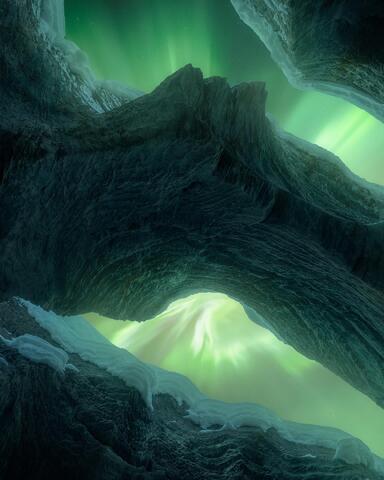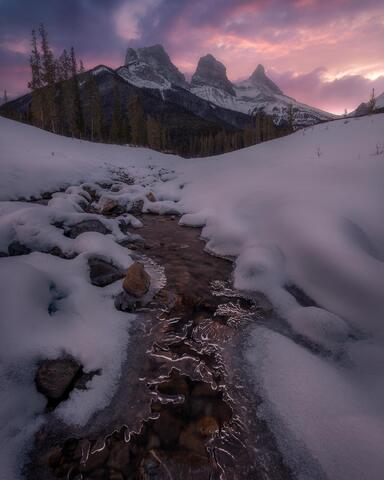
The Beauty of Winter's Simplicity
I truly love to photograph landscape images. In most situations, my to-go lens will be an ultra-wide angle: my Canon 11-24mm f4.0. I don’t know why…something just sparks for me when I use that specific lens. I love my ability to be able to give a lot of presence to both the foreground and background in the image. And thanks to the fact that I often shoot close to the ground, I can also manage to limit the amount of unwanted mid-ground. To me, it’s a win win type of scenario. I will almost always shoot dawn, sunrise, sunset and then dusk. What would I be looking for between sunrise and sunset? Go to bed and sleep all day? Of course not…
That’s in fact a good question that is repeated. People want to know what I do with my free time during the day. During my daytime, I often like to explore and scout for locations to be photographed later. I like to be well prepared for when the light kicks in! I definitely don’t want to miss an opportunity. Most of the time, that’s what I will be doing.
When you see a spectacular mountain with an amazing foreground, the shot will very likely become obvious. But there is much more than the obvious grand scenes. Daytime is the perfect time to capture the not so obvious details. What I mean by not so obvious details is intimate and abstract photography in general.
Since the light is very unlikely to change rapidly and will for the most part be far from optimal, why not turn our attention to lesser obvious things? The main goal of this Blog Article is to inspire you to look for these kind of scenes and to open your eyes to the Beauty of Winter’s Simplicity.
.
FROZEN WATERFALLS
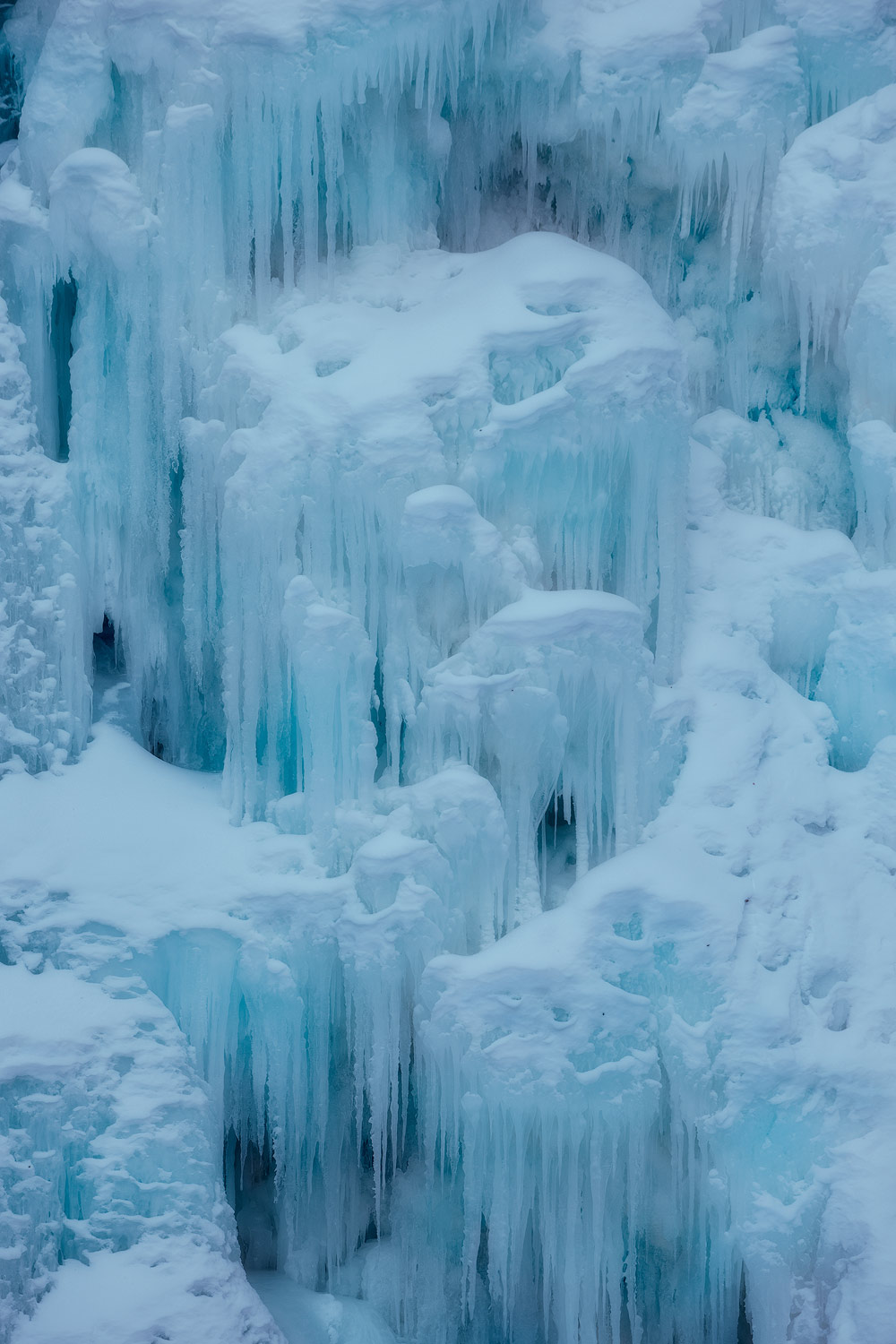
I truly love waterfalls. I think that for those that have been following my work for years all know that I love long exposure photography. I love a good scene that involves a beautiful waterfall! I love to be standing near water. I love the sound of water, I love to slow down the exposure time just enough to create a fuzzy looking water surface with just the right a mount of detail. It brings me joy…I feel 100% zen at a waterfall!
If I am being honest, winter isn’t going to serve me well in the waterfall department since most of them are going to be frozen at some point. Sad right? Does that mean I will not visit them at all? Of course not! I truly love a frozen waterfall. I especially love a partially covered waterfall. When water is as clear as in the Canadian Rockies and it freezes, the ice becomes bright cyan. It makes a great colour contrast between ice and snow. How to process with a frozen waterfall? I highly recommend not photographing the whole thing though. What I love to do is to mount my telephoto zoom lens to my camera, I will zoom out and try to find specific parts of the waterfall that could potentially create a great composition. I want repetitive icicles, I want repetitive diagonal lines…I want to balance the composition by including just enough of the waterfall. Remember, in a lot of situations, less often becomes more!
.
RICH SNOW DETAILS
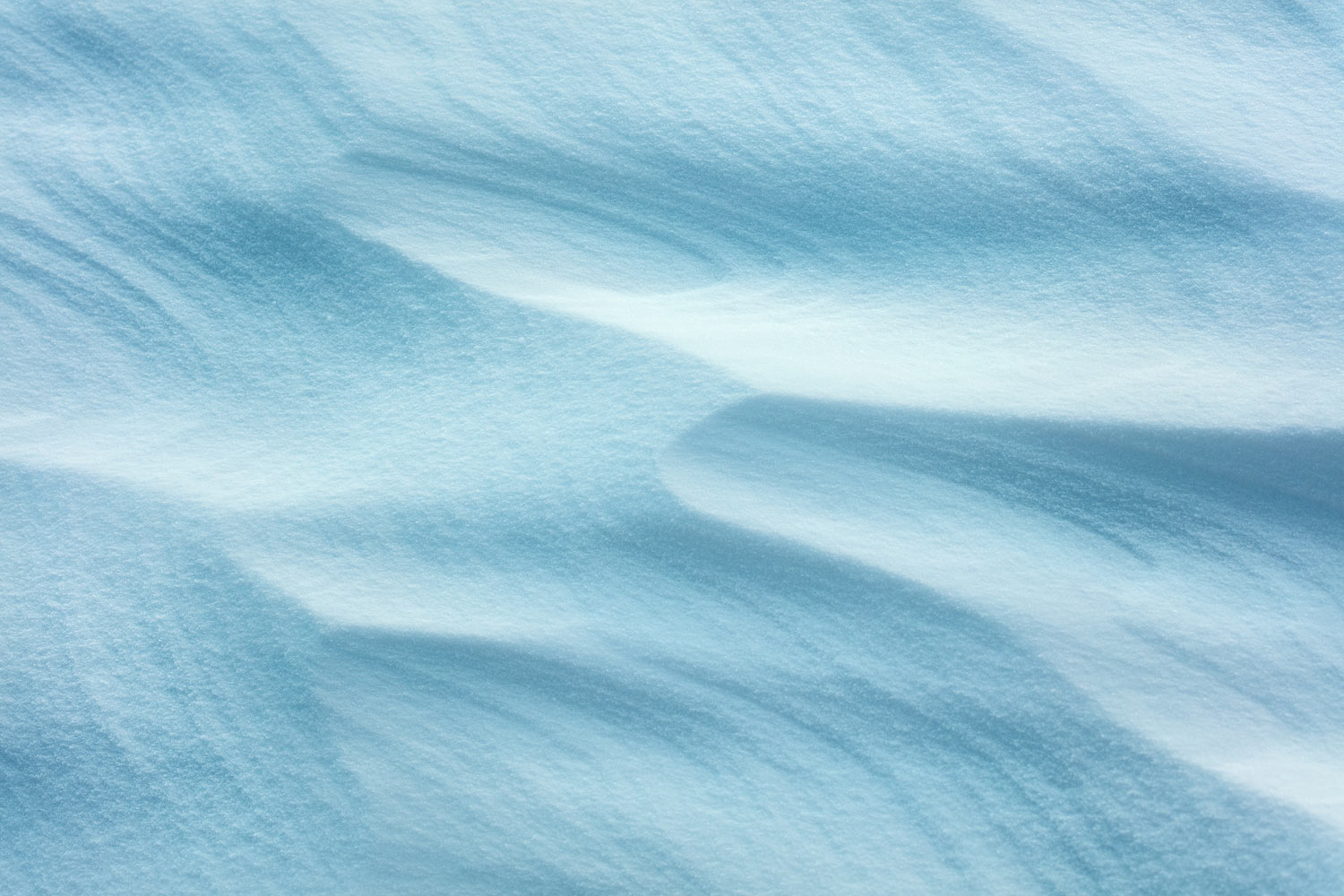

I often shovel my driveway and rarely do I notice the rich details of the snow directly underneath my feet. And I am sure the same applies to you. We just want to clean the dam thing as soon as possible! The ground on which we rest our feet can be an amazing canvas, a truly amazing Artwork. You simply need to pay attention to what’s on the ground…
On that specific day at Abraham Lake, I had just finished capturing a lovely sunrise and almost about to leave. My equipment was all packed and my breakfast was calling. The light right after sunrise was a bit too harsh for my liking until some light clouds rolled in and softened the contrast. And all of a sudden, the whole ground transformed into a real piece of art. The amount of detail in each small snow drift was truly mind boggling. Guess what, I got my camera out of the bag again and started capturing the pure beauty of snow abstracts. Some of these images reminded me of sand dunes while others were reminding me of a video game I used to play a while ago: Mahjong. I love all the repetitive shapes and lines…and all those details just got the perfect amount of accentuation thanks to the soft light.
.
DRAMATIC PINE TREES
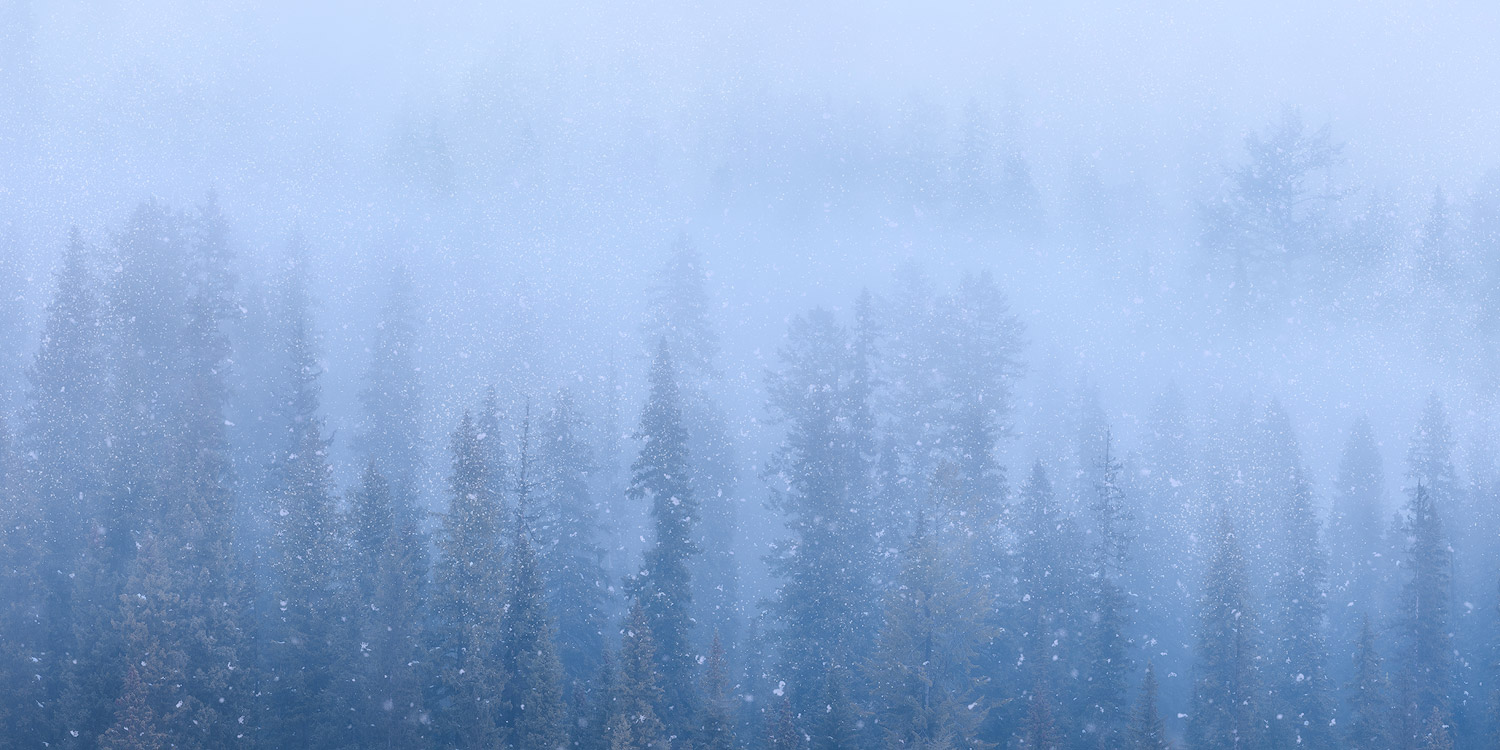
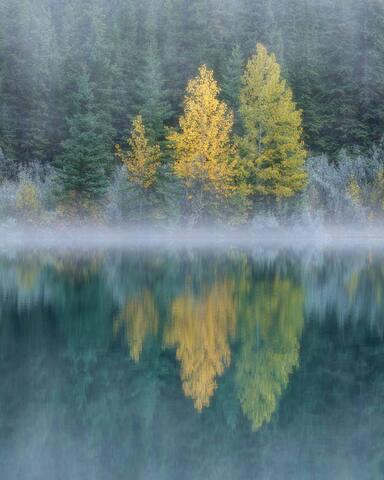
I remember two years ago when Gina and I were guiding our winter workshop in the Canadian Rockies. Our plan was to shoot a sunset at Emerald Lake and based on the weather forecast, it was looking very promising. It was a fairly short ride so we gave it a shot. But once we arrived, it was foggy and pretty grim. Since the Emerald Lake Lodge cabin is a very iconic image to get in the winter, all our participants went ahead and captured many shots. I mean, the image of that amazing snowy landscape with a cute little wooden cabin right next to a partially frozen lake with a reflection and surrounded by ginormous mountains all together screams loudly Canada!
On that particular evening, the fog was drifting quickly and the scene was changing every couple of seconds. I once again took my long lens out and mounted it to my camera, then mounted the two of them to my tripod. I started scanning the whole scene until I came across this. The atmosphere was dense, adding depth to the whole scene. We could easily see one first row of trees with a second one almost fully hidden behind…again, a not so obvious image right next to the iconic scene with the cabin. The moment I showed what I had just captured to my workshop participants, they were all extremely excited to swap lens and get a little bit of that too.
.
ICE TEXTURE AND CRACKS
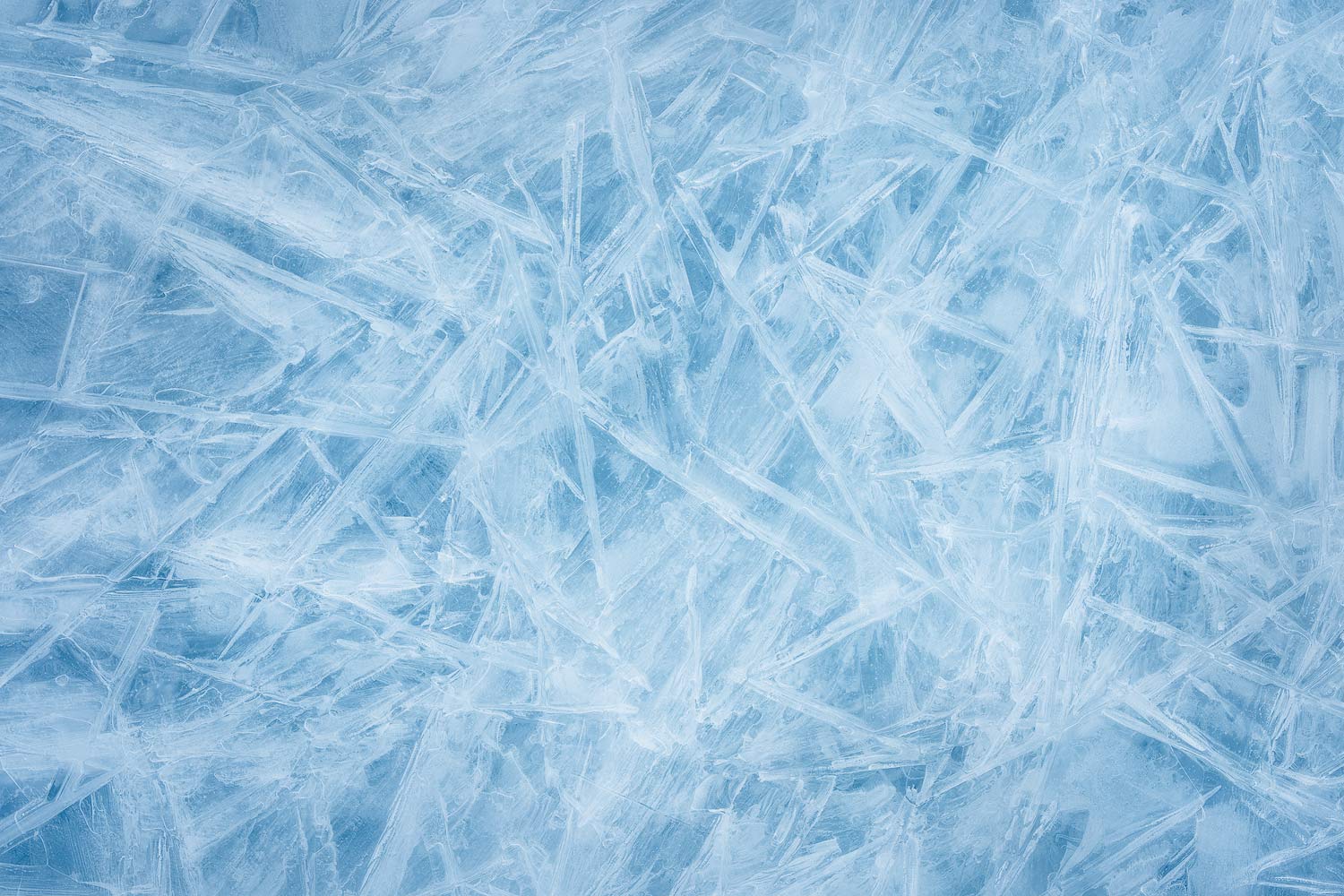

I am not going to lie, I love to spend time on frozen lakes when it’s safe, of course! It’s a true pleasure for me to photograph ice texture and cracks. I normally use cracks as leading lines which will lead my viewers’ eyes to the main subject of the composition. Anything else we could do with these cool ice details? By pointing the camera straight down to the ice, I often try to find converging lines and/or repetitive patterns to tell a story.
The most logical first thing to note here is that the ice must be thick enough to stand on. Parks Canada recommends at least 15cm for the ice to be safe. Ice cracks will often be a good reference point to estimate the thickness of the ice. I always avoid stepping on grey or white ice. Not being able to see through the ice makes it difficult to effectively estimate the thickness. The darker ice will always have less air content and be much more dense. The best way to estimate the ice thickness is to use the right tool, an ice screw but not everybody has one. So always use common sense and avoid putting yourself in a potentially dangerous situation.
.
COMFY SNOW PILLOWS
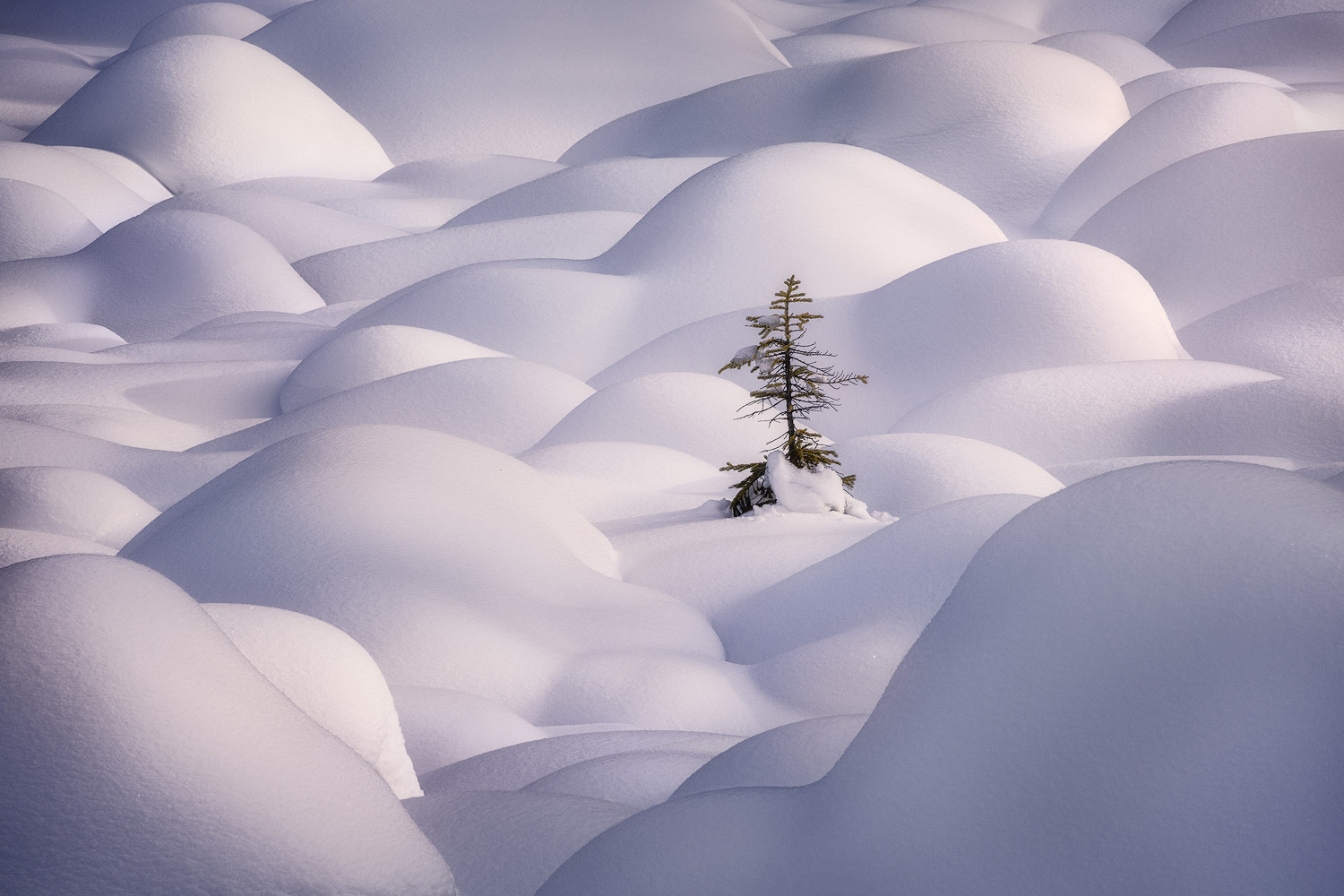
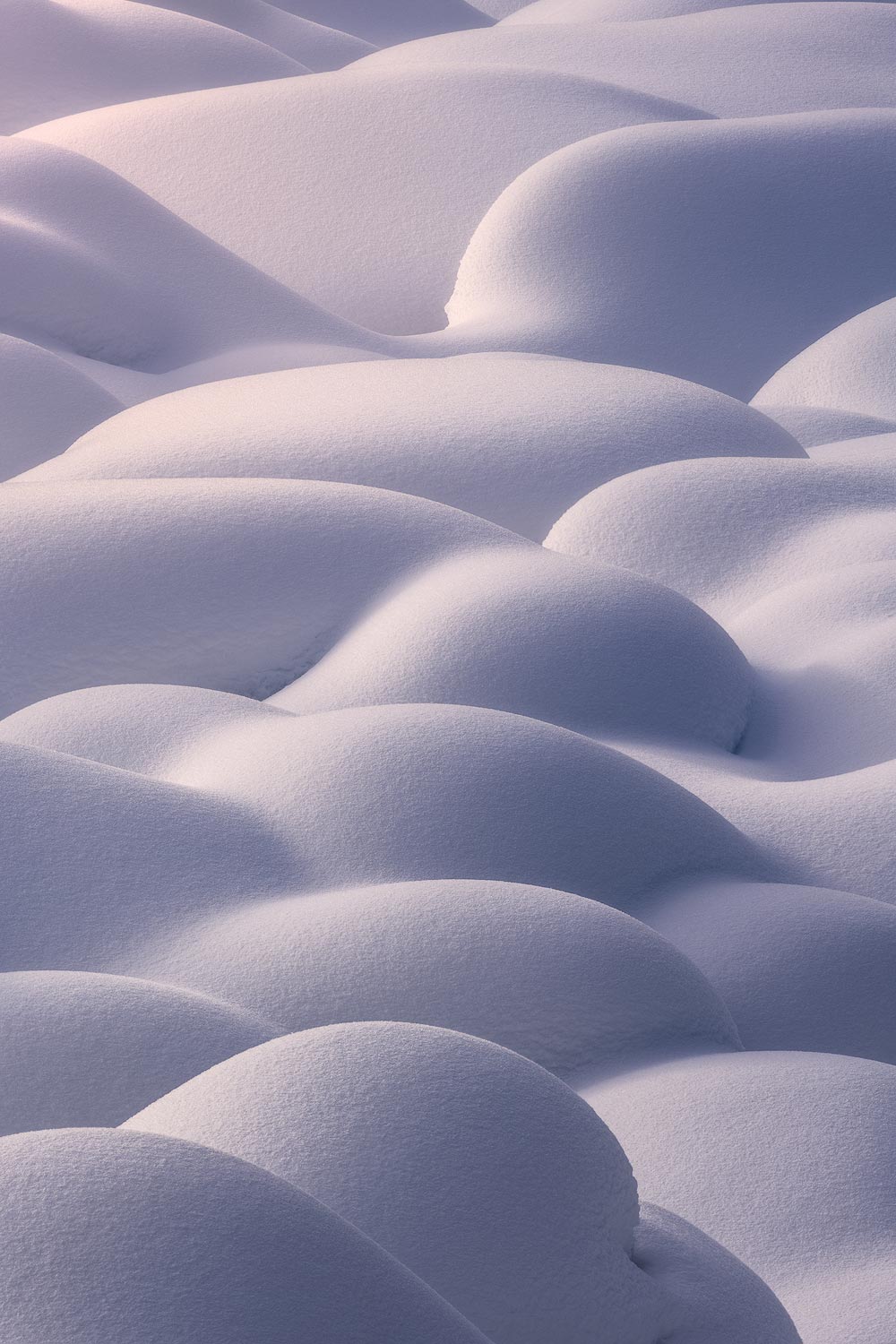
One can only admit that those snow pillows are looking so damn comfortable. At first sight, you just want to lay down in there. But trust me…they aren’t comfortable at all! Ask me how I know! Joke apart…the first time I went to this awe-inspiring location in Jasper, I though it was a great idea to venture into the field. There was a small tree and I wanted to get closer. My attempt to get closer to that tree was everything but exciting. I even got stuck for a while between two of the snow pillows.
What are these exactly? A long time ago, there was a big land slide from the mountains and it carried a ton of big boulders near the main road. In fact, if you drive to Jasper during the summer season, you will drive by this location and you’ll probably just tell yourself: That’s just a bunch of rocks…
In the winter season, when the whole field is covered with snow and you happen to get just the right amount of soft light, the place really starts to sing opera. It’s such a fun location to photograph. The scene looks so simple yet elegant. And thanks to the fact that the winter sun stays very low in the sky, there’s a good chance to get premium light there almost all day. The contrast can become a bit too intense with a clear sky. A thin layer of cloud that covers the whole sky and softens the light just like a soft box is what you want. I love to photograph Snow Pillows. I always try to find a small baby tree which will at the same time contrast the round shapes of the pillows while adding some zest of darker tones. I also love to find multiple repetitive similarly shaped curves one after another. It adds a great sense of depth to the image. Snow Pillows can be found in many other places..that one place in Jasper just so happens to be my favorite.
.
ABUNDANCE OF BUBBLES
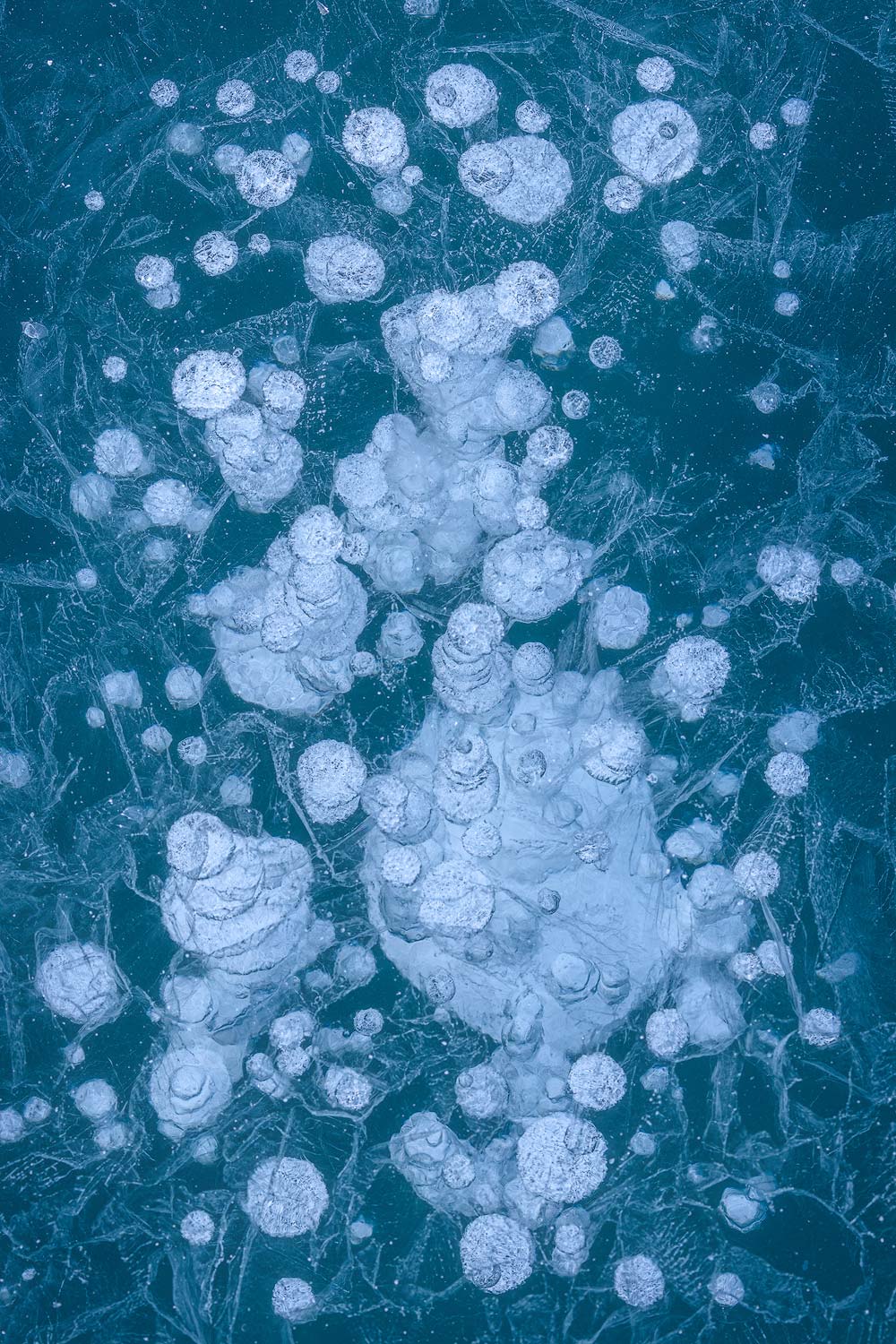
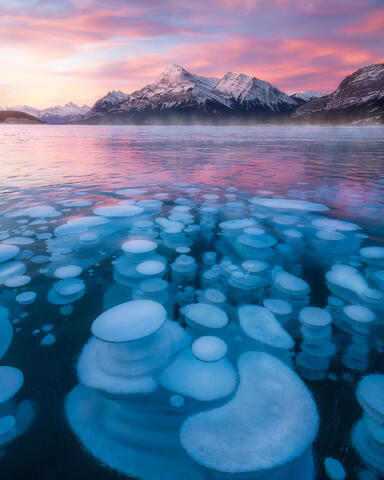
Methane Bubbles are such a joy to photograph. There’s always an abundance of bubbles in the Canadian Rockies. They have such a striking look when used as a foreground. The stacked bubbles also called pancakes are adding a great amount of three dimensional aspect to the image. It’s difficult to add dimension to an image when photographing a flat surface such as ice…the stacked methane bubbles are the ones you want.
As an abstract subject, I love to photograph methane bubbles just as much. Once again, I will make sure to find a lovely patch of bubbles that is constructed of multiple layers. We definitely want the pancake bubbles here again. Since we are photographing the ice with the camera facing straight down, we need to find a way to introduce a sense of depth. Otherwise everything will look so flat. The pancake bubbles will do just that. One thing to keep in mind, Focus Stacking might be necessary otherwise you might end up with the first bubbles only in perfect focus…and every other bubble underneath out of focus. Unless you are ok with that, you should definitely consider Focus Stacking.
.
ELEGANT CURVES
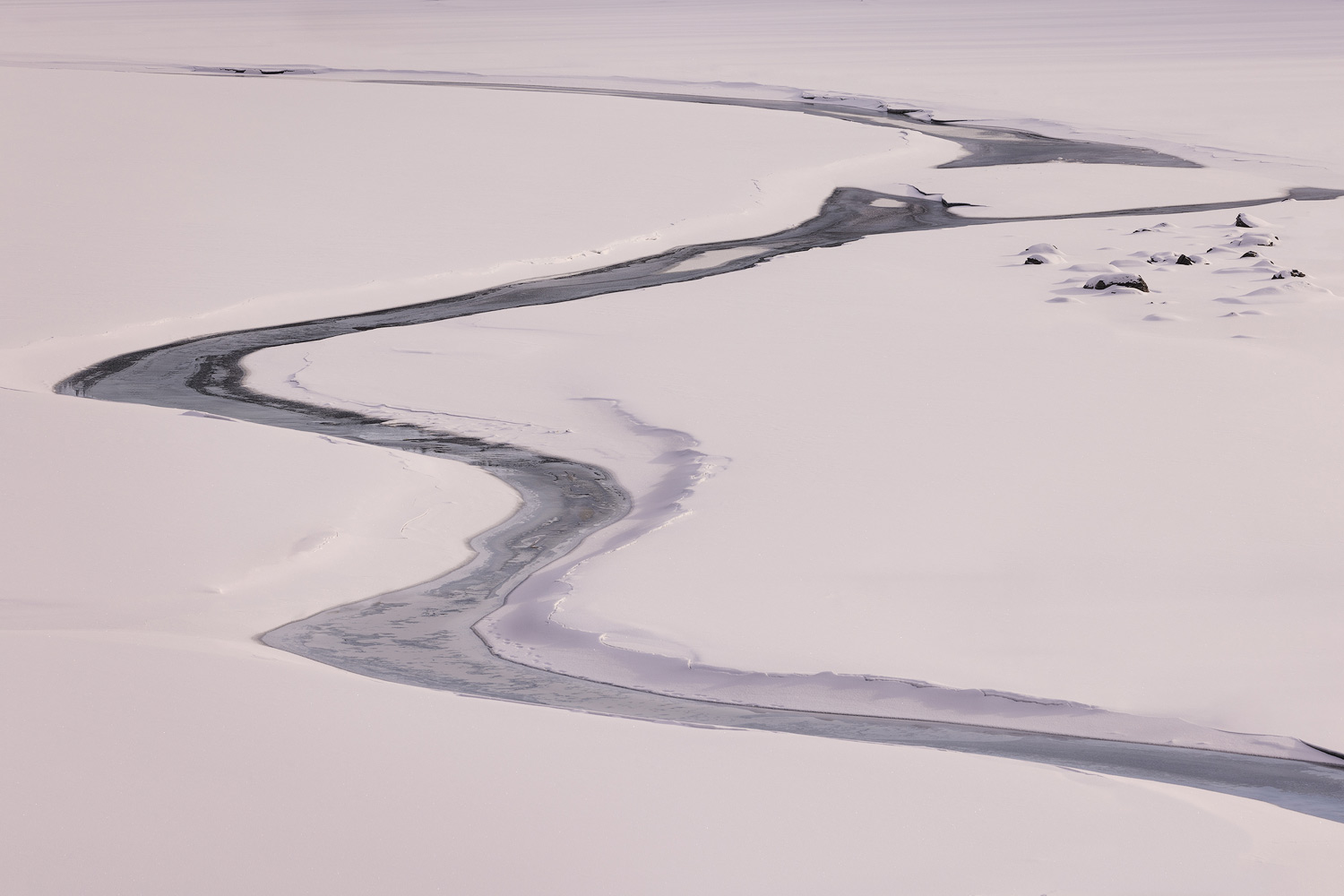
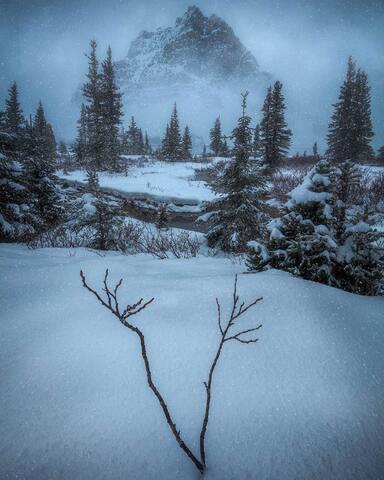
Elegant Curves will surely create an impact in any composition. To have a lovely S shaped curve will always help our eyes to travel freely and effortlessly throughout the composition. Both images shown here wouldn’t even be possible during the summer season. Winter has the power to cover most if not all the possible distractions leaving us with a blank canvas. Small creeks and narrow rivers will eventually pop out as the snow will collapse over flowing water.
On that early afternoon, I was driving with a friend in Jasper National Park with high hopes of finding something interesting to photograph. The lake was fully frozen…yes, that’s a frozen lake fully covered with snow and as the temperature warmed up a bit, a narrow S shaped channel formed, allowing the melting snow to flow back to the lake. It is a simple subject that most people wouldn’t even notice but it was truly worth stopping for a few minutes to try to create something lovely out of it. I composed the image in such a way that the S would flow from two opposite corners. Since snow is omnipresent in the scene, the S shaped creek is contrasting very nicely with its surroundings.
.
…IN CONCLUSION
In conclusion, you can probably see that none of these images were obvious at first sight. It was a matter of stopping, staring at the scene for a while and capturing something out of the ordinary. I heard many of my workshop participants saying that even though they enjoy looking at images like these, they weren’t appreciating the experience of creating them. That’s 100% understandable. It takes a lot of practice. It takes years of trial and error before you can create your first abstract or intimate image that you’ll be happy with. It took me a long while too but now, I always make sure to capture a few intimate images no matter where I go.
I had published another similar Blog Article in the past. If I got your attention and are looking to learn more about this topic, click on the link to read it: INTIMATE PHOTOGRAPHY: LESS IS MORE
We don’t need many elements in an image to make it work…all we need is to use them wisely. We photographers don’t use words to tell a story…let’s allow our images to tell a story that’s worth a thousand words.